
Guest post from Aaron Eischeid
For 2019, as part of a goal to develop a habit of reading more, I set an objective to finish one book per month. This turned out to be a good pace for me, and having that goal in mind helped me on many occasions decide to pick up the same book I was already reading rather than get sucked off into deciding what I felt like reading at that particular moment. In other words, it pushed me to be content with what I had already decided was worth reading, and actually read it, instead of getting mired by analysis of potential new books for 30 minutes, and then not really getting into reading anything.
I don’t know why it is but a different book always sounds more enticing than the book I already am in the midst of. For whatever reason this goal of actually finishing 1 per month helped get me beyond that just a bit. YMMV.
I ended up slightly past my goal, but maybe some of this was cheating, at least three or four of these were started prior to 2019. I’ll offer a mini review of each (in no particular order) – including why I read it, thoughts & impressions, and recommendation
- The Broken Earth Trilogy (#2 The Obelisk Gate, #3 The Stone Sky ) – N K Jemisin
- I had already read book one and liked it.
- Good character and world building. Nice blend of sci-fi and fantasy genres. My first Novel with female main characters in … I don’t know, too long I guess.
- It’s a good trilogy, but the books don’t stand well individually in my opinion, so if you’re looking for a long story this fits the bill, but not so much if you just want to dabble.
- It Doesn’t Have To Be Crazy At Work – Jason Fried, David Heinemeier-Hansson
- Working in web-development there is a lot of hype around the hustle culture or startup mentality that I have never been very comfortable with
- These guys do a nice job calling BS on a lot of the bad practices of tech companies in particular but they also mostly speak from a position of having already ‘made it’. That weakens things a bit. Also there is a noticeable lack of advice to those legitimately struggling to make it not because of bad products or company culture but because current economic systems or environments are stacked against them.
- Probably a worthwhile read if you work in software at all – I don’t know of any others in that space writing as consistently from this angle
- Winners Take All: The Elite Charade of Changing the World – Anand Giridharadas
- Think I saw a retweet of something poignant that Anand said, followed some links, came upon the book, read the premise and decided to get it.
- This was one of those books that while reading I would have to get up pace around and mutter about under my breath to talk myself down a bit. He really pulls back the curtain on the way the rich and powerful are yanking us all around, and it is a little hard to just sit there and read it.
- This book is important. If you care about politics or how the world is shaped in any way you should, at the very least, get to know the core argument. The book really does flesh out the bones of the core argument in a way that maybe only a book can. So it’s definitely worth reading.
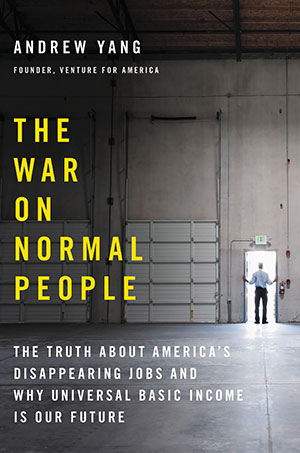
- The War On Normal People – Andrew Yang
- UBI is a great idea. Yang is the first presidential candidate I know of to make this a core policy position, so when I heard he had a book related to UBI I snagged it from the library.
- His focus is automation along with its second and third order effects, and thus his case for UBI, in the book at least, is primarily one of practicality for a changing economy. A rather important and convincing line of reasoning. Previously I saw UBI as more of a solution to poverty and wealth inequality the current context, or that of the recent past, he helped convince me our economic context is already in the initial stages of radical change, and if we don’t make some moves soon the poverty and wealth inequality problems are going to increase exponentially.
- I reviewed this one more thoroughly here
- Maybe. There is a lot of material out there that might be better or more expedient than the book at this point. Yang is still in the race for the nomination, so if you’re in the US I’d definitely recommend checking out what he has to say one way or another before your chance to vote in your local caucus or primaries passes.
- Team Human – Douglas Rushkoff
- Sean shared a podcast episode, I wanted to hear more. Found it at the library
- Enjoyed and can get behind the spirit of this one for the most part. A strong and unnecessary tie-in to evolutionary psychology was off putting to me. There’s a resemblance to Jacques Ellul’s The Technological Society in some of the core ideas. Of course contemporary examples and language give these ideas some new appeal no doubt.
- Maybe, if you’re not already skeptical of mass media, automation, and algorithms and their unhealthy influences in our lives then at least check out the podcast by the same name, if you already are a skeptic, like me, and really want to entrench these ideas with some deeper philosophical underpinnings, then maybe check out some contemporary analysis of Ellul on YouTube instead.
- Utopia For Realists – Rutger Bregman
- Referenced in some of my online reading on UBI, and saw some quotes from the book on twitter – the title is intriguing all by itself!
- Lots of interesting history, and good discussion of some big ideas.
- Sure, even if you already believe in UBI or open borders or other such things there is probably some new good info to bolster your positions. If you don’t even know what those things are also a concise enough to be a good introduction, as you won’t get bogged down or bored by details.
- The Power of Habit – Charles Duhigg
- I think I saw this one in an airport bookstore a couple years ago, had started reading it on the plane, but never finished for no good reason.
- Given I studied Psych in college I found a couple of the more recent case stories very interesting. At least one of these will almost certainly be in learning and memory psychology textbooks in the future. On the other hand all the business-oriented stories about how marketing teams cleverly manipulated peoples behavior annoyed me as they were portrayed in much too positive a light.
- This book could have been a TED talk. It’s good core idea, but it didn’t need to be stretched into a full book
- The Subtle Art of Not Giving a F*ck – Mark Manson
- Honestly just picked this one up because it seemed popular and potentially irreverently funny
- The irreverence wears thin, the self-help advice is not bad, but pretty surface level – mostly get priorities straight, and ignore the haters kind of stuff – very meh to me, but I guess it appeals to a lot of people, and if it helps them get priorities in order and lose some anxiety then, cool, I guess.
- Nah – I regret putting the time in on this one.
- The Dispossessed – Ursula K Le Guin
- Sean read one of her books and talked it up. I saw part of a PBS special about her and was intrigued. Was looking for a novel as a change of pace.
- Was slow going getting into it, but think that had more to do with personal issues that just happened to coincide. So glad I pushed through the first couple chapters. Honestly one of top 10 novels I’ve read in my life. Maybe top 5. Why dystopian novels like 1984 or Brave New World got so popular, but this is relatively unheard of is something I can’t explain well. Such good writing and ultimately a much more hopeful message
- Yes, Strongly recommend. It is part of a (loosely defined) series apparently, but it stands alone just fine
- 12 Hours of Sleep By 12 Weeks – Suzy Giordano, Lisa Abidin
- We had a baby in August. Have other children too. The best simple advice as a parent is you need a plan of attack for sleep. We’d tried other ideas with some success with our other kids, but were open to alternative approaches. This was recommended and fit that qualifier
- Good philosophically. Detailed plan kind of book, but the strong lean, near reliance, on bottle feeding made some of the plan just not doable or practical for us. This baby just didn’t do well with a bottle. ¯\_(ツ)_/¯
- It’s worth checking out if you have a new baby to deal with sometime soon, but don’t make it your only resource on the subject.
- Male Sexuality: Why Women Don’t Understand It – And Men Don’t Either – Michael J Bader
- Just stumbled across this at the library a few years back. Only skimmed some parts before had to return, but remembered it was one I had wanted to come back to.
- Some really novel thoughts, a lot that made sense, a bit that was a stretch. Overall very good stuff to contemplate, and some trailheads for paths of serious introspection are identified. Towards the end there is a section about the troubling lack of comprehension for pedophiles and similar deviant fantasy or behavior. Its not an appeal for leniency towards abusers, yet some will find his comparatively compassionate ideas probably appalling. I think his message there is quite important.
- If you are willing or wanting to get introspective about your own or your partner’s sexual thoughts and motivations this will give you some really good stuff to chew on for sure.
- The Case Against Sugar – Gary Taubes
- I get emails about discounts on ebooks. This one was on sale for 1.99 or .99 and the little blurb sounded interesting
- Long, but mostly in a thorough positive sense, as in it builds the case stronger with proper nuance, and without assuming too much prior knowledge. His conclusions are not oversold. Sugar, in the quantities the average person consumes it, is a serious problem. There are lots of important reasons the western diet came to be what it was, and remains what it is. Failing to understand all that would probably mean a failure to change them long term. An interesting blend of nutrition science, history, and politics. Also, the chapter on the role sugar played in cigarettes was almost literally jaw dropping for me.
- Recommend, but understand its not for everyone. Seems like pretty crucial reading if you want to understand the modern obesity crises, and its associated illnesses like diabetes, cancer, and heart disease, holistically. On the other hand, If you’re one who can simply take advice on authority, then one takeaway piece of advice would be cut your sugar intake WAY down. A second, to be skeptical of most modern health or nutrition advocates that aren’t giving that advice as step one. For example the pervasive “exercise more” or “eat less” messages – this is essentially sugar industry propaganda at work.
- How To Change Your Mind – Michael Pollan
- Heard an interview with the author on the radio not long after a discussion on personality types and their in-plasticity – lack of plasticity? un-plasticness? rigidity? well, anyway.
- I didn’t really enjoy the long winded tangents and character introductions littered throughout, but a friend listened to the audiobook at the same time I was reading it, and he appreciated that rambling style in that format. Plenty of surprising psychology history, and the premise that psychedelics have may have an important function is just really interesting. Not being much of a mystical person or experimenter in those things I found it difficult to relate to some of the ineffable experiences he tried to relay.
- If there were a condensed version I would be much more apt to suggest this one, the core content is good. Paul Stamets is one of the people interviewed and has a book that I also borrowed from the library, Mycelium Running – I didn’t “read” that one, only skimmed, which is why it doesn’t have a proper entry in this list. Lots of fascinating pictures with captions. My kids were also into it! I might recommend Paul’s book over this one. Torn on that. They definitely cover different stuff though.
- On Freedom, Love, And Power – Jacques Ellul
- I was looking for something more on the theological side of things from this guy
- Meandering commentary on Genesis, Job, and Revelation. I feel like it was interspersed with some insightful stuff, but I also remember thinking some was pretty off base. Honestly, I read this one early in the year, and there just isn’t much that stuck with me
- Nope. Wouldn’t call it a bad read, but there are just so many better.
That does it for my lightning reviews. Maybe this year I will try not to procrastinate writing these out. Probably better on the whole to get these out while they are fresh, but on the other hand it is interesting to mentally re-visit the book later on. It shouldn’t be surprising to find my opinion of a book can evolve a bit with time, after giving the new ideas time to digest just a bit and mix well with the other new ideas etc.
I plan to follow this post up with two more related to the building a habit of reading. One on utilizing books with daily entries, and one about filling in some practical details and lessons learned as I venture to achieve the seemingly simple goal of finishing one book a month again in 2020.

 Eclectic Reading List