Posts

When Breath Becomes Air – Paul Kalanithi

paul kalanithi when breath becomes air

A neurosurgeon’s quest for meaning while living with terminal cancer

When Breath Becomes Air is a Pulitzer Prize finalist that was written by Dr Paul Kalanithi and published posthumously. It is an autobiography of the author’s life and the years surrounding his cancer diagnosis, treatment, and death. In it, he explores the struggles he faced in his quest to become a top neurosurgeon, his personal relationships, and what it felt like to be on the opposite side of the doctor-patient relationship. He also shares his quest to find meaning and purpose in life.

Topics

Career as calling – The author reflects on the demands, physical and emotional, that surgeons (especially neurosurgeons) face as they climb their way through medical school and the years of residency afterward.

Search for meaning – Dr Kalanithi traces his search for meaning and purpose in life from his early childhood days through med school and to the very end of his life. He offers a very candid take on how he dealt with those deep, existential questions of life.

Life as a cancer patient – Though he had much experience in interacting with cancer patients and performing countless surgeries to remove cancer, life is very different on the other side of the doctor-patient relationship. These sections of the book are very moving and profound.

Recommendation

This book will tug at your heartstrings. It was a bit of an emotional rollercoaster in sections for me and I know the same will be true for others, especially those who have lost loved ones to cancer. It’s amazing how much a book like this can change your perspective in many areas of life. If you’re up for the journey, this book is a well-needed dose of humanity.

Here is a link to the Wiki page for this book. You can find the book on Amazon here.

About Us: Essays from the Disability Series of the New York Times

about us new york times disability essays

Authors with disabilities share their stories while challenging stereotypes and ableism

About Us is a collection of some 60 essays from authors who have some type of physical or mental disability. The stories in this book are very powerful and address the discrimination, stereotypes, and obstacles that people living with disabilities face in our society. These essays cover a wide range of topics from a diverse background of authors. It offers a unique perspective about how everyone experiences disability differently, but also how much we all have in common in the human experience.

Topics Covered

Mental and physical disabilities – The authors included in this book share what it is like to live with various physical and mental disabilities – rare genetic conditions, acquired disabilities, neurological conditions, mental health issues, and much more. One thing I really appreciate is that it’s not a competition about who is more disabled than others, pitting one condition or experience against another.

Identity – Each author has their own way of addressing labels and self identity. Do you use person-first language, or not? How do you define your own experience and how you relate to the world? Some authors resent the term disability while others embrace it. The viewpoints are as diverse as the authors themselves.

Stereotypes and prejudice – The Americans with Disabilities Act has helped people with disabilities in many ways, but there are still major issues with discrimination, lack of access, and prejudice when it comes to employment, healthcare, relationships, education, and social settings. Discrimination isn’t always obvious, sometimes it’s a feature that is built into our culture and society.

Recommendation

I strongly recommend this book. I am a huge believer in the power of stories to change the way we think about things. That’s likely no surprise if you’ve been following this blog at all. This book will challenge any hidden stereotypes, misconceptions, and ableist views you may have. It will also help you to see, with fresh eyes, the obstacles that disabled folks face in everyday living, relationships, finding meaningful employment, and the prejudice they encounter. I especially enjoyed the introduction by Andrew Solomon, who captures the variety of experiences and struggles those with disabilities have in identity, limitations, and self-perception.

You can find and buy the book on the New York Times website here. Here’s a link to find the book on Amazon.

Stories of Your Life and Others – Ted Chiang

Ted Chiang Stories book cover

A superb collection of short stories that will make you think

This book is a collection of short stories (all but one in this collection have been published previously) from author Ted Chiang. Mr Chiang is a multiple-time winner of the Nebula and Hugo awards, as well as other awards for excellent science fiction and short story writing. Most of the stories in this book are set in the future or in some type of alternate reality. Much like author Le Guin and The Left Hand of Darkness, this isn’t your typical sci-fi or fantasy writing. The blockbuster movie Arrival was based on the title story in this book, The Story of Your Life.

Topics/Themes

Consciousness – what if there was an alien race that experienced reality and consciousness different from humans? What would that look like and what would it mean?

Faith/Religion – what does true devotion mean and how would we live in a world where the supernatural was an everyday part of life for all?

Scientific progress – what are the potential ramifications that we could face with various advances in technology? What are the possible ethical and moral issues we might encounter if our technology advances faster than our humanity?

Recommendation

I really enjoyed this book and these stories. Not only are they well written, but they also make you think about some part of life/humanity in a new way. I felt this same way when reading Ursula Le Guin. Most of the stories here start with the premise of something along the lines of “what if this one thing was different – how would that change things?” The book is scientific and philosophical without being too heady. Plus, I think that the short story format is a really nice change of pace from reading novels.

Here’s a wiki link to learn more about this book. Here’s a link to the wiki page for author Ted Chiang, since it doesn’t appear that he has a website.

Animal Farm – George Orwell

animal farm george orwell book cover

A novel of political satire depicting the Soviet Union under Stalin

Animal Farm, by George Orwell, is parody or allegorical telling of the Russian Revolution and aftermath, in a fairy tale style setting. It is a very popular book that is often included in many “best novels” lists, including the list I posted previously – the top 100 reading list – which you can find here. It was written during the latter part of World War II but the author originally had difficulty finding a publisher as the USSR was an ally of England at that time. The book became very popular after the war, especially as the Cold War began to intensify.

Here’s a good description of the author’s background and purpose of the book, from Wikipedia:

According to Orwell, the fable reflects events leading up to the Russian Revolution of 1917 and then on into the Stalinist era of the Soviet Union. Orwell, a democratic socialist, was a critic of Joseph Stalin and hostile to Moscow-directed Stalinism, an attitude that was critically shaped by his experiences during the Spanish Civil War. The Soviet Union, he believed, had become a brutal dictatorship, built upon a cult of personality and enforced by a reign of terror. In a letter to Yvonne Davet, Orwell described Animal Farm as a satirical tale against Stalin (“un conte satirique contre Staline”), and in his essay “Why I Write” (1946), wrote that Animal Farm was the first book in which he tried, with full consciousness of what he was doing, “to fuse political purpose and artistic purpose into one whole”.

Wikipedia Animal Farm entry – https://en.wikipedia.org/wiki/Animal_Farm

Themes

Inequality – The farm animals suffered greatly under the mismanagement of Mr Jones, the original owner of the farm and land. The lack of care provided and abuse from Mr Jones is what leads to the initial revolt by the animals. In the early part of the rebellion, animal equality is enshrined as part of the 7 commandments.

Corruption of power – The pigs become the early leaders and organizers of the rebellion and during the transition to animal takeover of the farm. But slowly one particular pig begins to exert more and more influence and begins to use his power to banish and kill any animal who would question him. This new ruling party begins to violate almost all of the 7 commandments and to make revisions so as to justify their behavior.

Influence of propaganda – One pig in particular, Squealer, is the main instrument of propaganda. He is the one who changes the commandments and gives the official orders to stop singing the song of rebellion, alter the history of the rebellion, and spread rumors to make Snowball the enemy and Napoleon the true hero.

Hypocrisy of the Soviet Union – If you are able to get a version that contains the preface and appendix that Orwell wrote to go with this book, you’ll see his reasons for why he portrayed Stalin and the USSR in such unflattering terms. At the initial time of writing, very few were willing to acknowledge the gigantic hypocrisy happening under Stalin and how the initial Russian Revolution, which was supposed to help the peasants, had instead turned into a corruption of power and a ruling party that stood against many of the things that the Revolution fought against.

Recommendation

This is an interesting book and an easy read. As an allegory, it is a warning of how quickly power can corrupt and the horrible things that can happen under totalitarian rule. In that way, this novel is similar in warning to Orwell’s later book, 1984. Personally, I found 1984 to be a much more compelling book and prefer it to Animal Farm. But still, I feel like this book is important as a piece of satire, especially considering the time it was written. If you aren’t familiar with Russian history, the Wiki link included below will help you to identify the animals and events portrayed in this book. It felt a bit slow developing in parts, but I liked it overall.

Here’s a link to the Wiki page for Animal Farm.

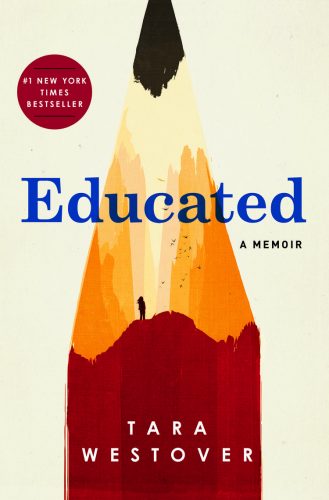
Educated: A Memoir – Tara Westover

Educated book cover

A story of surviving fundamentalism and finding freedom

Educated, by Tara Westover, is a really powerful story that covers a roller coaster of emotions. It is a memoir that details what it was like for the author to grow up in an extreme fundamentalist home in rural America. Her family (specifically her father) was deeply suspicious of the government and didn’t allow their children to go to school or to receive medical care – she didn’t get a birth certificate until she went to college. The book covers family relationships, fears about the outside world, and the author’s journey to finding her own identity.

Trigger warning: There are multiple episodes of physical, emotional, and psychological abuse throughout the book that could cause relived trauma for those who have experienced such things.

Topics

Mental health/illness – Though he never gets a formal diagnosis, it is clear that her father suffers from some clear symptoms of paranoid schizophrenia, mania, major depression, and some possible personality disorder issues. A brother clearly has some violent tendencies of his own that are not addressed either medically or by the family. The author also details what appears to be a major depressive episode of her own while working towards her PhD.

Abuse and Resilience – The author traces her journey from homeschooled (more accurately no-schooled) child to university and eventually earning a PhD. Childhood adversity and resiliency is a topic that I’ve covered before in this blog with the book Supernormal. Trauma is a complex thing and what makes some more resilient than others is worth an entire book itself.

Identity – Dr Westover continuously wrestles with which version of reality to believe – the one she sees when she’s out in the world with her grandparents and people in town, or the one presented by her paranoid, conspiracy obsessed father? This struggle might be hard for some to accept or understand, but it is a struggle that people in abusive and manipulative relationships have to endure.

Recommendation

I strongly recommend this one. It deserves all the awards and excellent reviews it has gotten. My only caution would be for people who have experienced childhood trauma. This book doesn’t sugarcoat or skip out on the details. I had to skip over more than a few sections. You might also need to do the same.

You can connect with the author on her website here and on Twitter here.

P.S. Here’s an interview with Bill Gates and Tara Westover

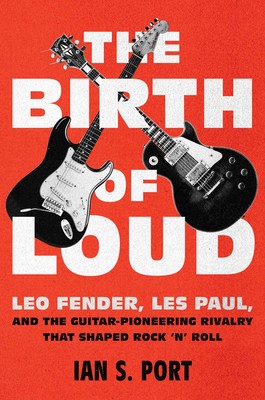
The Birth of Loud – Ian S. Port

ian s port the birth of loud book cover

Leo Fender, Les Paul, and the Guitar-Pioneering Rivalry That Shaped Rock ‘n’ Roll

Here’s a departure from the usual on the eclectic reading list blog. I love music and play a few different instruments, including guitar. I enjoy many different types of music, but I’ll always have a soft spot for rock and roll. In this book, author Ian S. Port chronicles the history of the development of the electric guitar through innovators Leo Fender, Les Paul, and others. It’s an enjoyable story, whether or not you play guitar yourself or like rock music.

Here’s a good synopsis from the publisher’s website:

“In the years after World War II, music was evolving from big-band jazz into rock ’n’ roll—and these louder styles demanded revolutionary instruments. When Leo Fender’s tiny firm marketed the first solid-body electric guitar, the Esquire, musicians immediately saw its appeal. Not to be out-maneuvered, Gibson, the largest guitar manufacturer, raced to build a competitive product. The company designed an “axe” that would make Fender’s Esquire look cheap and convinced Les Paul—whose endorsement Leo Fender had sought—to put his name on it. Thus was born the guitar world’s most heated rivalry: Gibson versus Fender, Les versus Leo.

While Fender was a quiet, half-blind, self-taught radio repairman, Paul was a brilliant but headstrong pop star and guitarist who spent years toying with new musical technologies. Their contest turned into an arms race as the most inventive musicians of the 1950s and 1960s—including bluesman Muddy Waters, rocker Buddy Holly, the Beatles, Bob Dylan, and Eric Clapton—adopted one maker’s guitar or another. By 1969 it was clear that these new electric instruments had launched music into a radical new age, empowering artists with a vibrancy and volume never before attainable.”

Topics

Innovation leaders – The author does a great job of presenting the reality of the people involved, including their brilliance and flaws. I really appreciate that he includes a historical timeline of who came up with what, and when, while also acknowledging that no one single person can be credited with “inventing” the solid-body electric guitar as we know it today.

The arms race to be the best – Like most breakthrough innovations, things like the solid-body electric guitar, electric bass, special amps, and the like were largely rejected by those “in the know.” Once these things finally caught on, the race was on to perfect the instruments and be the leader in production and sales of this new technology. Competition between old friends and acquaintances was often heated.

Famous (and not famous) guitar pioneering musicians – While some musicians like Les Paul became well known, many other brilliant musicians aren’t known, even among music fans. I really appreciate that players like Muddy Waters are given some space to shine. Hendrix, Clapton, and other rock gods get their due, but this book doesn’t overlook those who came before.

Recommendation

Like I mentioned in the opening paragraph, you don’t have to be a guitarist or even like rock music to enjoy this book (but I think you’ll love this book if you fall into either of those categories). It is as much about the race to innovate and create as it is about the actual music and instruments. I learned a lot through this and it was well written. I also really appreciated how it didn’t present a glossed-over view of the main characters involved, but let you see them for their brilliance and deep flaws alike.

Here’s a link to the author’s website. You can also find him on Twitter. Here’s a link to the book on the publisher’s website.

Fahrenheit 451 – Ray Bradbury

Ray Bradbury Fahrenheit 451 book cover

A dystopian novel where firemen burn books instead of putting out fires

“Fahrenheit 451 – the temperature at which book paper catches fire, and burns…” is the tagline for this classic, best-selling book by Ray Bradbury. In this future, dystopian land, firemen burn books instead of put out fires. This short novel is often included in many of the “best fiction” lists out there. It has also been targeted for banning/censorship.

I’d place this book, alongside 1984 and Brave New World, as the founding trinity of dystopian novels. Fahrenheit 451 has elements of both. It’s dark, but not nearly as dark as Orwell – and has some of the entertain-them-to-death feel as Huxley’s satire.

Themes

Censorship – This is a book about literal book burning, written during the era of the communist scare and Joseph McCarthy’s House Un-American Activities Committee. In this future world, knowledge is dangerous (especially books). Firemen go out and burn all the books they can find.

Population control through mass media – Similarly to Brave New World, the public is kept busy with sensationalist media and constant preoccupation with technology. If you keep people busy and their minds occupied, they will have no reason to want to read or even think on their own.

Recommendation

I liked this book and can see why it is often listed by people as a must read book. It’s not long at all and is an easy read. I find it highly ironic that a book which shows the dangers of censorship has been targeted and people have attempted to have it banned. I must say that a future like this would be absolute hell for introverts like myself.

You can find the book on Amazon here. Wiki link is here.

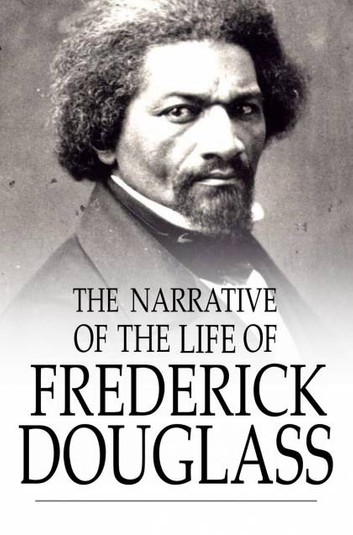
Narrative of the Life of Frederick Douglass, an American Slave – Frederick Douglass

narrative frederick douglass book cover

An autobiographical account of Frederick Douglass’s life and the truth about slavery in the United States

Frederick Douglass was born into slavery in the early 1800s and grew up to be one of the most influential voices in the abolitionist movement. This book is written in narrative form and covers his life from birth (approx 1818) until he escaped and became involved in anti-slavery meetings (approx 1840). Throughout the book, he describes the practices of slavery in the South, the dehumanization that happens because of it, and his determination to find freedom. This is a really important book because many of us who grew up in the United States have only an abstract understanding of the horrors of slavery and haven’t been exposed to what it was actually like.

Normally, this is where I would talk about the topics and themes of the book I’m reviewing. But I don’t think I can do it justice if I go that route. This isn’t a long book, so it really should be read in full to best understand it. I’ll share a few quotes in hopes that it will help give you an idea of what it is like.

Quotes

“Slaves sing most when they are most unhappy. The songs of the slave represent the sorrows of his heart; and he is relieved by them, only as an aching heart is relieved by its tears.”

“I have observed this in my experience of slavery, – that whenever my condition was improved, instead of its increasing my contentment, it only increased my desire to be free, and set me to thinking of plans to gain my freedom. I have found that, to make a contented slave, it is necessary to make a thoughtless one. It is necessary to darken his moral and mental vision, and, as far as possible, to annihilate the power of reason. He must be able to detect no inconsistencies in slavery; he must be made to feel that slavery is right; and he can be brought to that only when he ceased to be a man.”

“The more I read, the more I was led to abhor and detest my enslavers. I could regard them in no other light than a band of successful robbers, who had left their homes, and gone to Africa, and stolen us from our homes, and in a strange land reduced us to slavery. I loathed them as being the meanest as well as the most wicked of men.”

“I assert most unhesitatingly, that the religion of the south is a mere covering for the most horrid crimes, – a justifier of the most appalling barbarity, – a sanctifier of the most hateful frauds, – and a dark shelter under, which the darkest, foulest, grossest, and most infernal deeds of the slaveholders find the strongest protection.”

Recommendation

I consider this a must-read book. There’s such a lack of understanding among some groups of people, especially privileged white folks like myself, about what slavery was actually like according to the people who experienced it. What we grew up with is a white-washed version of the history of our country and slavery in particular. Powerful stories like this help to put a human face on the suffering and injustice. This forces us to look at it in a different way.

Here’s the Wiki page regarding this book. Here’s a link to buy the book, but you should know that this work is in the public domain and you can find several places online where you can read it for free – like Project Gutenberg.

There There – Tommy Orange

There There book cover

A novel about urban Native life in Oakland, but so much more

This novel comes out swinging with a powerful prologue then takes you on a journey into the urban Native experience. It covers the rollercoaster of human experience and addresses many of the stereotypes and discrimination that Indigenous people currently face, as well as the long list of abuses and genocide they have experienced. I am astounded that this brilliant and powerful novel is the first from author Tommy Orange. It feels like an epic in many ways, something on the level of East of Eden by Steinbeck. It’s no surprise that “There There” was a finalist for the Pulitzer Prize for Fiction.

A compassionate debut that, through 12 Native American narrators making their way to a California powwow, offers a chorus of voices struggling with questions of identity and authenticity.

Pulitzer Prize website – https://www.pulitzer.org/finalists/tommy-orange

Themes

Native/Indigenous history and culture – The author explains the history of abuses, massacres, and attempts by the US government to wipe out anything Native American – things that aren’t often fully taught (or taught at all) in American schools today. Tommy Orange explores how this history has forever changed the cultures of current-day tribes and Indigenous people.

Identity and Authenticity – Almost all of the characters struggle to find some type of identity. Several are from mixed backgrounds and/or don’t have a relationship with their Native biological parents. Others are trying to reconnect with their heritage, but are faced with self-doubts and the tension of feelings about reconnecting.

Recommendation

This is a must-read book. It will likely be painful to read. Painful for those who have experienced the ugliness that comes from racism, discrimination, poverty, addiction, and violence. Also painful for those who didn’t realize that these things are current issues, not some artifact from the past. It is both eye-opening and soul-opening. Some books take you on a journey and have the power to change you in the process. I believe “There There” is one of those books. Highly recommended.

I couldn’t find a website for the author. I’ll update this section if/when I do. It appears that he has a Twitter account. Here’s a Wiki link to the page on the novel.

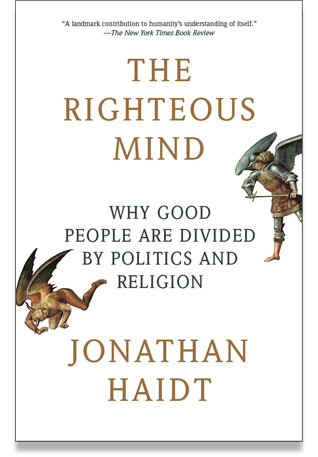
The Righteous Mind: Why Good People are Divided by Politics and Religion – Jonathan Haidt

righteous mind jonathan haidt book cover

What is the basis of morality and how does it influence our worldview?

In “The Righteous Mind”, professor and researcher Jonathan Haidt takes on the tall task of explaining how morality works, it’s possible origins, and how it directs us as individuals and cultures. He shows how humans are inherently moral creatures, but what typically divides us is how we view and interpret morality. This isn’t a fluff, pop-science book, it is a refreshingly honest look at the complex issues we face, done in a way that is far different than the heavy partisan takes out there.

Okay, with that intro bit out of the way, I feel like I need to say that you should just get this book and read it. I’m going to talk about some of the themes, but it won’t do a good enough job of capturing the nuance, important connections, and reasoning that this book excels at. And by nuance, I don’t mean in a “I’m afraid to talk about the issue directly so I’ll fill this space with complex and/or pedantic arguments detached from reality” type of nuance. I mean a focus on important subtleties regarding personality, cultural worldview, and definitions of morality. The author does a great job of breaking down some incredibly complex issues in an incremental way and provides the research to back up his reasoning.

Topics

Intuition comes before reasoning – The rider and elephant analogy helps to show how we like to think of ourselves as rational human beings who follow logic and principles, but we don’t work that way.

Morality isn’t just about harm and fairness – Professor Haidt shares his personal stories about how he came to see the importance of stepping outside of his moral matrix so that he could understand other moral foundations.

Moral Foundations Theory – “There are (at least) six psychological systems that comprise the universal foundations of the world’s many moral matrices. Here’s a handy summary from the wiki page on MFT:

  • Care: cherishing and protecting others; opposite of harm
  • Fairness or proportionality: rendering justice according to shared rules; opposite of cheating
  • Loyalty or ingroup: standing with your group, family, nation; opposite of betrayal
  • Authority or respect: submitting to tradition and legitimate authority; opposite of subversion
  • Sanctity or purity: abhorrence for disgusting things, foods, actions; opposite of degradation
  • Liberty: opposite of oppression

Morality binds and blinds – Humans are both selfish and groupish by nature. The mental imagery the author uses is that we are 90% chimpanzee and 10% bee. He also suggests how religion played a crucial role in human evolutionary history, enabling us to “transcend self-interest and become simply part of a whole.”

The reasoning behind our political and religious differences – Morality binds us together and we easily fall into groupish behavior and righteousness. This binding process blinds us from our weak spots and can cause us to be unable to understand how anyone could possibly see things differently.

Recommendation

I can’t recommend this book enough. It covers a lot of ground (research, psychology, history) without turning into an abstract/detached textbook. The author does a great job of mixing in personal stories to help illustrate points and admits to his own blind spots/weaknesses. It’s very refreshing to read a book that addresses such hot topics in an evenhanded way. Time will tell if moral foundations theory holds up, but it definitely goes a long way in helping to understand how good, well-intentioned people can view and experience the world so differently.

Quotes

I’m going to add some of the most interesting quotes from the book here, but please know that there’s a much deeper context here. So I really recommend reading the book to be able to grasp the big picture and context of each quote.

“We are deeply intuitive creatures whose gut feeling drive our strategic reasoning. This makes it difficult – but not impossible – to connect with those who live in other matrices, which are often built on different configurations of the available moral foundations.”

“We may spend most of our waking hours advancing our own interests, but we all have the capacity to transcend self-interest and become simply part of a whole. It’s not just a capacity; it’s the portal to many of life’s most cherished experiences.”

“Morality binds and blinds. This is not just something that happens to people on the other side. We all get sucked into tribal moral communities. We circle around sacred values and then share post hoc arguments about why we are so right and they are so wrong. We think the other side is blind to truth, reason, science, and common sense, but in fact everyone goes blind when talking about their sacred objects.”

“Anyone who tells you that all societies, in all eras, should be using one particular moral matrix, resting on one particular configuration of moral foundations, is a fundamentalist of one sort or another.”

“We evolved to live, trade, and trust within shared moral matrices. When societies lose their grip on individuals, allowing all to do as they please, the result is often a decrease in happiness and an increase in suicide, as Durkheim showed more than a hundred years ago.”

“Moral systems are interlocking sets of values, virtues, norms, practices, identities, institutions, technologies, and evolved psychological mechanisms that work together to suppress or regulate self-interest and make cooperative societies possible.”

“If you think about religion as a set of beliefs about supernatural agents, you’re bound to misunderstand it…religious practices have been binding our ancestors into groups for tens of thousands of years.”

“The human mind is a story processor, not a logic processor. Everyone loves a good story: every culture bathes its children in stories. Among the most important stories we know are stories about ourselves…Life narratives are saturated with morality.”

“When asked to account for the development of their own religious faith and moral beliefs, conservatives underscored deep feelings about respect for authority, allegiance to one’s group, and purity of the self, whereas liberals emphasized their deep feelings regarding human suffering and social fairness.”

“The various moralities found on the political left tend to rest most strongly on the Care/harm and Liberty/oppression foundations. These two foundations support ideals of social justice, which emphasize compassion for the poor and a struggle for political equality among the subgroups that comprise society.”

“If you are trying to change an organization or a society and you do not consider the effects of your changes on moral capital, you’re asking for trouble. This, I believe, is the fundamental blind spot of the left. It explains why liberal reforms so often backfire, and why communistic revolutions usually end up in despotism…Conversely, while conservatives do a better job of preserving moral capital, they often fail to notice certain classes of victims, fail to limit the predation of certain powerful interests, and fail to see the need to change or update institutions as times change.”

Learn more about the book and author here. Here’s a link to the Wiki page for the book. Lastly, here’s that link again to learn more about Moral Foundations Theory.